
 |
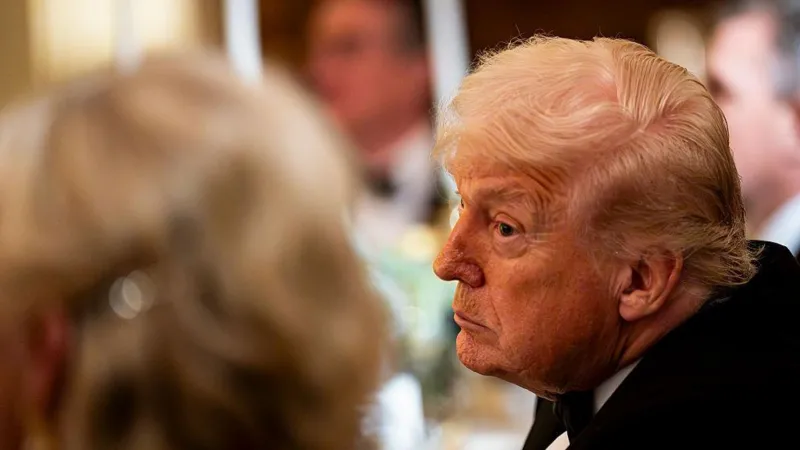
| Trump's trade representative asserts that US tariff policy "hasn't changed." (Image: Getty Images) |
Despite the Supreme Court's decision on Friday to reject a legal justification used by Trump to impose numerous such tariffs, the US president's trade representative has maintained that the tariff policy "hasn't changed." In an interview with ABC News on Sunday, US Trade Representative Jamieson Greer stated, "The policy hasn't changed, but the legal tool to implement it might change." Imported goods face taxes known as tariffs. The businesses that import foreign goods pay the tax to the government. In April, the Supreme Court ruled that Trump's use of a single tool to enact a global program of tariffs exceeded his authority. The ruling only applied to Trump's use of the 1977 International Emergency Economic Powers Act (IEEPA), which was the primary reason for the majority of the tariffs he imposed during his second term. In the meantime, a tangled web of more specific tariffs that target American imports of particular goods or imports from particular nations continues to exist. Other products are exempt from this.
Read More News: Empara Mi's music has previously featured in TV shows such as Love Island and video games such as Fortnite
In response to the Supreme Court's decision, the US president immediately announced a new tariff rate of 10% on all imports of goods through a different piece of legislation. He increased this to 15% on Saturday. On Tuesday, the new rate will take effect. "roughly equivalent to the types of tariffs that we have in place under IEEPA," Greer stated of this plan. Trump's current legislation can only be used for 150 days, after which Congress must be consulted for an extension. In the meantime, Green pointed out in comments to ABC that his administration is also looking into other legal options for raising tariffs. Greer provided an explanation, "We found ways to really reconstruct what we're doing." "Now, it doesn't have the same flexibility as the president had under his previous authority, but he gives us very durable tools," The president of the United States has long argued that tariffs will increase domestic manufacturing and lead to job creation, and he has also used them to achieve a number of other political goals. Additionally, he has attempted to justify his policy in terms of national security. He has stated that the United States faces an "extraordinary and unusual threat" from its trade deficit, which occurs when the country imports more goods than it exports. But critics have warned that tariffs result in higher prices for consumers and damage to the global economy.
The Federal Reserve Bank of New York's analysis, which was released earlier this month, found that US businesses were responsible for paying for 90% of the increased tariffs that Trump imposed on goods from Mexico, China, Canada, and the European Union (EU).
The various nations that negotiated individual deals with the United States following the announcement of the IEEPA tariffs in April have been left in a state of uncertainty as a result of Friday's Supreme Court ruling. The White House announced on Friday that these nations would be subject to the new global blanket tariff rate, which at the time was 10% and was later increased to 15% by Trump the following day. The official went on to say that the Trump administration hopes these nations will continue to honor the concessions they agreed to in the trade deals. We are going to support them. In a separate interview with CBS News on Sunday, Greer discussed the deals. "We expect our partners to stand by them." The United Kingdom is one of the countries that are affected. Prior to the Supreme Court's decision, the country had agreed to a tariff rate of 10% on most goods. However, it now appears that it will have to pay 15%. The UK government has said it expects Britain's "privileged trading position with the US" to continue.
Everywhere you look, small businesses have voiced their dissatisfaction with the uncertainty brought on by tariff regimes that are constantly shifting. According to Fraser Smeaton, co-founder of a UK costumes company that exports approximately 60% of its products to the US, the year had been a roller coaster, highlighted by additional turmoil following the court decision. Smeaton stated on BBC Radio 4's Today program that the tariffs on Trump's goods increased from zero to thirty percent on the day he announced the IEEPA tariffs in April. They then increased to 100 percent, then to 145 percent, and finally to a rate of 30 percent. This changed later to 20%, and a few hours after the ruling on Friday, it was back to zero, then up to 10%, and then 15% on Saturday. "We've had to deal with an awful lot of upheaval and uncertainty."
 |
| US President Donald Trump offering speech (Image: BBC) |
Trump, on the other hand, described the decision made by the Supreme Court on Friday as "ridiculous, poorly written, and extraordinarily anti-American." The possibility of consumers and businesses receiving refunds for the estimated $130 billion (£96 billion) they have paid as a result of Trump's IEEPA tariffs is another question that hangs over the matter. Trump himself has previously expressed concern regarding the issue's potential complexities.
The Supreme Court's decision that these tariffs were illegal did not provide any advice on how to return any money. In his own interview with CBS on Sunday, Treasury Secretary Scott Bessent, another important Trump official, emphasized that fact. He stated that he anticipated the issue being considered by a lower court. "Tariff revenue will be unchanged this year and will be unchanged in the future," Bessent stated, echoing Greer's assertion that the Trump administration would successfully navigate the Supreme Court ruling.
Source: BBC
#bbc #international #USA #Business




 Posts
Posts


0 Comments