 |
| About 20% of global oil and gas flows through the Strait of Hormuz (Image: Getty Image) |
Any ships attempting to navigate the Strait of Hormuz, which is the busiest oil shipping channel in the world, will, according to Iran, be "set on fire." The Gulf's narrow shipping lane typically receives approximately 20% of global oil and gas. But Iran's General Sardar Jabbari said that Tehran will now "not let a single drop of oil leave the region".
Uncertainty and disruption to international trade caused by Iran's response to US and Israeli strikes has already ratcheted up oil prices.
Blocking the strait could further inflate the cost of goods and services worldwide, and hit some of the world's biggest economies, including China, India and Japan, which are among the top importers of crude oil passing through the waterway.
Read More: China removes three retired generals from national advisory body
What is the Strait of Hormuz - and where is it?
One of the most vital oil transit chokepoints and one of the world's most important shipping routes is the Strait of Hormuz. Bounded to the north by Iran and to the south by Oman and the United Arab Emirates (UAE), the corridor – which is only about 50km (31 miles) wide at its entrance and exit, and about 33km wide at its narrowest point – connects the Gulf with the Arabian Sea.
The major Middle Eastern oil and gas producers and their customers make use of the strait, which is deep enough to accommodate the world's largest crude oil tankers. According to estimates from the US Energy Information Administration (EIA), approximately 20 million barrels of oil would pass through the Strait of Hormuz each day in 2025. This amounts to nearly $600 billion (£447 billion) worth of energy trade annually. This oil comes from Iraq, Kuwait, Qatar,
Saudi Arabia, and the United Arab Emirates, in addition to Iran.
 |
| How US-Israel war with Iran is jeopardising shipping (Image: BBC) |
What would be the impact of closing the strait?
About 3,000 or so ships sail through the strait each month.
Analysts have warned that the longer there are threats to ships passing through the strait, the higher the price of oil - and the shipping of it - will be.
Arne Lohmann Rasmussen, chief analyst at Global Risk Management, a provider of energy market insights, stated to CBS News, the BBC's US partner, "It is de facto closed in that no one dares to go through." "You can be attacked, and you can't get insurance or it is extremely expensive, so you have to wait until the security situation is better... The market would suffer greatly if oil and gas coming from the strait were cut off, he added. "While there is no physical blockade, threats from the Iranians, plus drone and missile attacks, mean tankers are not going through the strait."
After at least three ships were attacked over the weekend near the Strait of Hormuz, the global benchmark
Brent crude briefly reached $82 (£61) a barrel on Monday. That has left about 150 tankers stranded, according to the Reuters news agency.
The cost of hiring a
supertanker to transport oil from the Middle East to China has nearly doubled from last week's price, reaching a record high of over $400,000 (£298,300), according to data from the London Stock Exchange Group. Countries in the Gulf, like Saudi Arabia, whose economies are heavily dependent on energy exports, will also be harmed by the closure of the crucial shipping lane.
Iran, by comparison, exports about 1.7 million barrels per day, according to the International Energy Agency. Iran exported $67bn (£50bn) worth of oil in the financial year ending March 2025 – its highest oil revenue in the past decade – according to estimates by the Central Bank of Iran.
Asia will also be severely impacted by a strait blockade. In 2022, around 82% of crude oil and
condensates (low-density liquid hydrocarbons that typically occur with natural gas) leaving the Strait of Hormuz were bound for Asian countries, according to EIA estimates.
Around 90% of Iran's exported oil is thought to be purchased by China alone. Higher oil prices may also result in higher prices for consumers worldwide due to China's use of that oil to manufacture goods for export.
How can Iran close the strait?
Countries can exercise territorial sea control within 12 nautical miles (13.8 miles) of their coastline, according to
UN regulations. At its narrowest point, the Strait of Hormuz and its shipping lanes lie entirely within Iran and Oman's territorial waters.
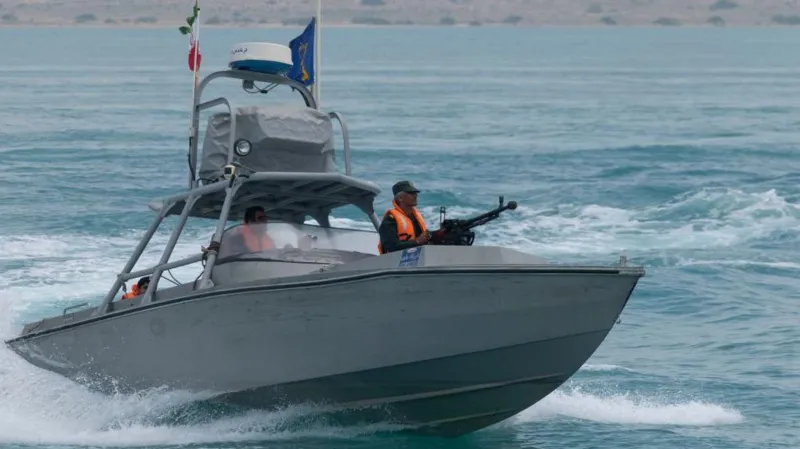
Experts say that laying mines using fast attack boats and submarines would be one of the most effective ways for Iran to close the strait, though the exact method is unknown. Attacks on foreign warships and commercial vessels could be launched by Iran's regular navy and the IRGC navy. However, large military ships may in turn become easy targets for US air strikes, and US President Donald Trump has said that one of his aims is to destroy Iran's navy.
Iran's fast boats are often armed with anti-ship missiles, and the country also operates a range of surface vessels, semi-submersible craft and submarines.
The US has previously used its military might to re-establish the flow of maritime traffic through the strait.
In the late 1980s, during the eight-year Iran-Iraq war, strikes on oil facilities escalated into a "tanker war" that saw both countries attacking neutral ships to exert economic pressure.
Kuwaiti tankers carrying Iraqi oil were especially vulnerable. According to the US Naval Institute, American warships eventually began escorting them through the Gulf in one of the largest naval surface warfare operations since World War Two.
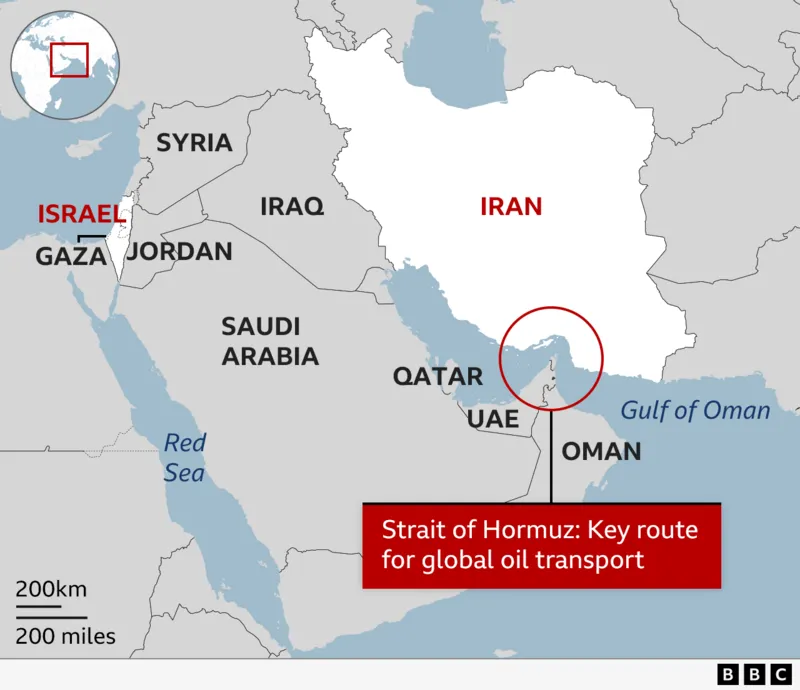 |
| Maps Of Hormuz Strait (Image: BBC) |
Can alternative routes offset the blockade?
Over the years, oil-exporting nations in the Gulf region have developed alternative export routes due to the persistent threat of the Strait of Hormuz closing. The EIA says that Saudi Arabia runs a 1,200-kilometer pipeline that can carry up to 5 million barrels of crude oil per day. It has also used a natural gas pipeline to transport crude oil for a short time in the past. The United Arab Emirates has connected its inland oilfields to the port of Fujairah on the Gulf of Oman via a pipeline with a daily capacity of at least 1.5 million barrels.
According to Reuters, the alternative infrastructure could be used to divert oil away from the Strait of Hormuz, but this would reduce supply by 8-10 million barrels per day.
Source: BBC


 Posts
Posts


0 Comments