
 |
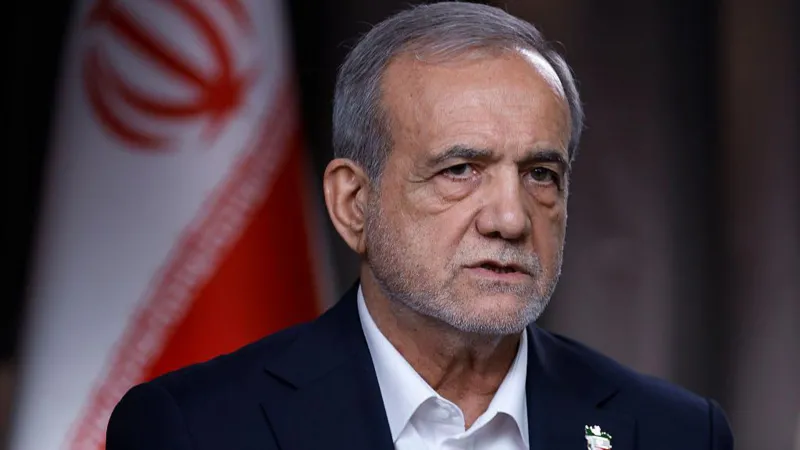
| Why did the president of Iran apologize? (Image: Getty Images) In an address that he delivered on Saturday morning as part of the country's interim leadership, Iran's President Masoud Pezeshkian surprised many observers by apologizing to Iran's neighbors for the strikes that had been carried out against them recently. The wording stood out because state-to-state apologies are uncommon, particularly during active conflict. Most of the time, leaders say "regret" or avoid responsibility. Instead, Pezeshkian made a straight admission that Iran's neighbors had been hit, saying that Iranian forces had been asked to stop hitting them unless Iran was attacked from their territory. He stated, "I deem it necessary to apologize to attacked neighboring countries." "We have no intention of invading neighboring nations," That alone raises the initial inquiry: was this an actual apology, and if so, why now? It's possible that the interim leadership is attempting to contain the growing regional conflict. After American and Israeli strikes on Saturday, February 28, some countries in the region were caught in the crossfire. Following the initial wave of strikes, which resulted in the deaths of senior Iranian commanders and disruptions to central command structures, Pezeshkian suggested that these attacks were carried out under "fire at will" instructions. |
He may be attempting to convey that Tehran does not want to turn the war into a larger regional conflict by apologizing. The message also implicitly acknowledges a political fact: even if some of Iran's neighbors let US forces operate from bases on their territory, Iran runs the risk of further isolating itself if it targets them openly. However, it is much less clear whether the apology will affect policy. According to reports from the region, Iran-related or its forces-related strikes have not yet stopped. On Saturday afternoon, both Qatar and the United Arab Emirates claimed to have stopped missiles aimed at them. If attacks like these keep happening, they'll make Iran's fractured leadership structure's control even more complicated to understand. Decision-making has shifted to an interim leadership council since the first wave of attacks killed key figures like Supreme Leader Ayatollah Ali Khamenei. In theory, that structure gives people like Pezeshkian more power than they had under a system ruled by a single supreme authority before. However, it is still unclear whether powerful security and military organizations like the Revolutionary Guards can be controlled in practice. If, despite the president's statement, Iranian-linked strikes continue to target neighboring states, this would indicate either a lack of communication or opposition from factions unwilling to reduce the conflict. Hardline elements within the security establishment have long argued that regional pressure is Iran's strongest deterrent against US and Israeli military power.
Reactions at home also show that tension. Pezeshkian's remarks have already been criticized as weak by hardliners. The current political moment in Iran is unusual: several of the most powerful hardline figures at the top of the system are gone, but many lower-ranking officials and commanders remain deeply suspicious of any conciliatory tone. For them, apologising to foreign governments risks appearing as capitulation at a time of national crisis. A very different narrative has shaped the response outside of Iran. Donald Trump quickly claimed on Truth Social that Iran had "apologised and surrendered" to its neighbours, arguing that the move proved US and Israeli military pressure was working. The language also reveals how Washington may interpret Tehran's signals. Trump has repeatedly insisted that Iran's "total surrender" is the only acceptable outcome. There is a diplomatic paradox in that demand. In the past, despite the intensity of the bombing, nations rarely accepted unconditional surrender during air campaigns alone. It would be extremely difficult to force such a result without ground forces. Interpreting Pezeshkian's apology as a form of capitulation could therefore serve as a political bridge for Washington: a way to claim progress without formally abandoning the demand for surrender. The calculation may differ for Pezeshkian and the interim leadership council. Achieving a ceasefire now could stabilise the situation before a new permanent leader emerges. If the next figure to dominate Iran's political system were a hardline cleric, the prospects for diplomacy could become even narrower. Another strategic question is posed by this possibility: is Pezeshkian presenting himself as a negotiable figure, the kind of leader Western governments might prefer to work with? In his address, he tried to balance defiance and openness, rejecting surrender while signalling restraint towards neighbouring states. At the same time, the conflict over who will lead Iran in the future is already taking shape. The current crisis may present an opportunity for a number of political and clerical figures, as well as commanders of the IRGC and security forces, to advance their positions. Some are urging the Assembly of Experts to select the next leader as soon as possible. Competitors may argue that a more hardline approach is required if Pezeshkian fails to provide stability or assert control over the armed forces. For the time being, the immediate test is outside of Iran. In an effort to determine whether the apology results in actual changes on the ground, numerous neighboring nations have so far responded cautiously or remained silent. Israel may be less likely to interpret the message as a genuine step toward de-escalation because it views the conflict as a rare opportunity to weaken Iran's long-term threat. It's possible that the ambiguity was chosen. There are a number of possible interpretations for Pezeshkian's apology, including a genuine effort to ease tensions in the region, a tactical move to buy time for Iran's interim leadership, or the first sign of a political repositioning within Tehran itself. In a conflict shaped as much by internal power struggles as by external war, it may be all three at once. |
Source: BBC


 Posts
Posts


0 Comments