
 |
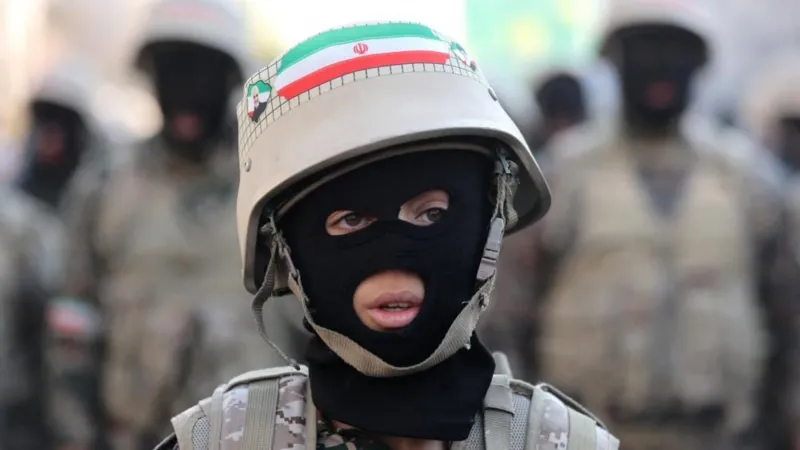
| A member of Iranian volunteer militia (Basij) attends a march in Tehran in January 2025, before the current war (Image: Reuters) |
A new initiative to recruit children into the security services has been brought into focus following the alleged death of an 11-year-old Iranian boy in an air strike in Tehran while he was assisting his father at a security checkpoint. According to the municipality-run newspaper Hamshahri, Alireza Jafari's mother Sadaf Monfared, the pair had been assisting Basij volunteer militia patrols and checkpoints to "maintain the security of Tehran and its people" when they were killed on March 11. An official from the Islamic Revolutionary Guard Corps (IRGC) in Tehran told the IRGC-affiliated Fars News Agency last week that the group would recruit "volunteers" over the age of 12. The BBC has been informed by witnesses that they have observed children, some of whom are armed, performing security duties in the capital and other cities. Foreign-based human rights organisations have also reported Alireza's death. According to the Kurdish group Hengaw, he was a "fifth-grade student" who was killed at a Tehran checkpoint. Alireza's mother said her husband had told her there were not enough personnel at the checkpoint, with "only four people" present. She claimed that he brought Alireza along and instructed the youngster to be "ready for the days ahead." She said, "Mum, either we win this war or we become martyrs," quoting her son. We will prevail, if God wills it, but I would like to die." According to the Hamshahri newspaper, they were struck by an "Israeli drone strike."
READ MORE: Hegseth calls on US allies to 'step up' over Strait of Hormuz
The BBC was informed by the Israel Defense Forces (IDF) that they were unable to verify this without receiving the coordinates of the alleged strike. The new program, Homeland Defender Fighters for Iran, according to Rahim Nadali of the IRGC's Greater Tehran Muhammad Rasulollah Corps, will assign children to a variety of tasks, such as patrols and deployment at checkpoints. He added that mosques affiliated with the Basij militia in Tehran and city squares where pro-establishment rallies have taken place could be places for recruitment. With an estimated one million members, the Basij is an IRGC-controlled volunteer militia. It is frequently used in the streets to silence opposition. Israel has said it recently targeted several Basij checkpoints.
Despite a government-imposed internet outage in Iran, the BBC has spoken to four eyewitnesses who said they had seen children under the age of 18 at checkpoints in Tehran, the nearby city of Karaj, and the northern city of Rasht.
For reasons related to security, names have been changed. Golnaz, who is in her 20s in east Tehran, told the BBC that she had seen armed teenagers taking part in Basiji forces when she went out after an air strike on 9 March to see what was going on.
Sara, who lives in west Tehran and is also in her 20s, told the BBC that on March 25, she saw a teenager at a checkpoint.
He was shooting at the cars with a gun. He and the others were searching and stopping cars. He was petite and short." The BBC heard from ordinary Iranians a month ago about security checkpoints all over the capital where people were stopped and searched. The BBC was informed by those who were able to connect to the internet that the practice is still in effect and that some patrols travel at night with the Islamic Republic's flag and loudspeakers. The BBC has been informed by some that adolescents have also been observed at checkpoints outside of Tehran. Peyman, who is in his 20s and lives in Karaj, told the BBC that on March 30, he saw what he described as a "teenage boy" armed with a Kalashnikov. "His moustache hadn't fully grown," he said.
According to the BBC, Tina, who is also in her 20s and is from Rasht, observed young people on duty in a city square on March 14. Their faces were covered because they were wearing masks. However, I can tell from their expressions that they are children because it is obvious. They are also brief. The adult forces are in front of them as they stand. I get scared and feel sorry for them at the same time." Human Rights Watch (HRW) described the recruitment campaign as a "grave violation of children's rights and a war crime when the children are under 15" in a report.
"There is no excuse for a military recruitment drive that targets children to sign up, much less 12-year-olds," said Bill Van Esveld of HRW. "What this boils down to is that Iranian authorities are apparently willing to risk children's lives for some extra manpower."
According to Pegah Banihashemi, a professor at the University of Chicago Law School who is an authority on constitutional law and human rights, "under international law, the use of children in security or military roles is tightly constrained and, in many contexts, unlawful." Additionally, she stated that their deployment "introduces broader risks to society: untrained minors operating under pressure, frequently with limited command structure and inadequate understanding of force, can unintentionally escalate violence and endanger civilians." According to the BBC, Holly Dagres, an Iran specialist at The Washington Institute for Near East Policy, stated that the utilization of children at security checkpoints "underscores the Islamic Republic's desperation." She stated that the fact that "it is struggling to recruit adults to staff security checkpoints and is resorting to using children in support roles during wartime" demonstrates "how deeply unpopular they are with their own population."
Source: BBC


 Posts
Posts


0 Comments