
 |
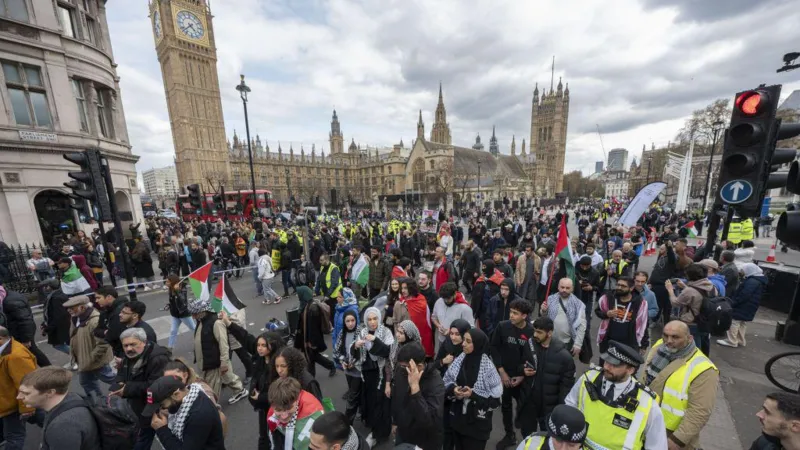
| Protesters at a previous Al Quds Day march in 2023 (Image: Anadolu via getty images) |
According to the home secretary, the request from the police to prohibit the Al Quds Day march in London on Sunday in order to prevent "serious public disorder" in light of the Middle East conflict has been approved by the government. The Metropolitan Police asked for the ban saying it was concerned about the high number of protesters and counter-protesters, adding the march organisers were "supportive of the Iranian regime" .
Read More: Palestinian Authority in dire straits as Israel's hold on West Bank deepens
The Islamic Human Rights Commission, who organise the annual march, insist it is a peaceful, pro-Palestinian event. It says a static protest will take place instead.
Since 2012, this is the first time a protest march has been banned. The Met said it had not taken the decision lightly.
Faisal Bodi, of the Islamic Human Rights Commission, said a ban would mean a "sad day for freedom of expression".
In a statement, Home Secretary Shabana Mahmood said: "I am satisfied doing so is necessary to prevent serious public disorder, due to the scale of the protest and multiple counter-protests, in the context of the ongoing conflict in the Middle East.
"The police will be able to impose strict conditions if a stationary demonstration proceeds. I expect to see the full force of the law applied to anyone spreading hatred and division instead of exercising their right to peaceful protest."
BBC London was informed by Met Police Commissioner Sir Mark Rowley that while he acknowledges the right to protest and freedom of speech, professional judgment and intelligence assessments indicated that the protests and counter-protests were "creating such a risk of violence that those marches needed to be banned." The force stated that the ban would be in effect starting at 16:30 on Wednesday for the Al Quds march as well as any associated counterprotest marches. It will run for a month. The Met described the Al Quds march as "uniquely contentious", saying it originated in Iran and it is organised by a group "supportive of the Iranian regime".
"This Al Quds march has got more tricky in recent years, its history is it's a construct of the Khomeini regime in Iran, that creates a unique threat and provocation in the UK," Sir Mark said.
"We've taken the unique step of going to the home secretary because the counter protests look just as hard."
 |
| Met Commissioner says request to ban Al Quds Day march was a 'unique step' (Image: BBC) |
Noting that the power to ban a march had not been used since 2012, Sir Mark added: "The public should bear in mind the last time we did this was 14 years ago, so this is rarely used, but occasionally a set of factors come together which get us across the threshold."
Previous Al Quds marches had "resulted in arrests for supporting terrorist organisations and antisemitic hate crimes", the force said.
Reacting to the decision, London Mayor Sir Sadiq Khan said "one of the joys of living in a democracy" is the right to protest".
However, in an interview with BBC London, he stated that the move "isn't diluting or diminishing the rights we have; it's this particular march the police have concerns with."
Outright ban 'extremely unusual'
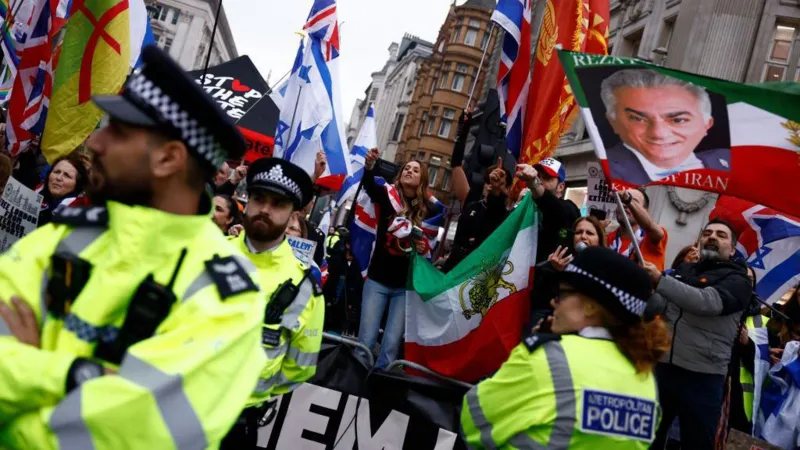 |
| Dozens of counter-protesters gathered during last year's march (Image: AFP/Getty Images) |
Source: BBC




 Posts
Posts


0 Comments