
 |
| Inside the Palestinian home attacked by settlers (Image: BBC) |
Standing in the charred remains of his family's large villa, which Israeli settlers attacked on Sunday, Barhan Omar asserts, "This assault wasn't just meant to burn the houses but also to kill - to kill women and children." "They came in big numbers. This was organised terrorism," he tells me, fighting back tears. "What's terrifying is that you're sitting in your house with your children, then suddenly you come under fire."
The Palestinian bank manager says settlers shot at his home in Deir al-Hatab, near Nablus, as well as setting it alight, and that he and his children escaped only by hiding on their roof.
Across the occupied West Bank, there has been a new spate of settler violence in recent days. During the rampage in Deir al-Hatab, at least 10 people were injured - mostly by thrown stones, with one man shot in the foot.
This is a village that has not previously experienced such a major attack, unlike other parts of the West Bank.
It followed the funeral of a young Israeli, Yehuda Sherman, at the nearby settlement of Elon Moreh, which was attended by hundreds of mourners and several leading Israeli politicians.
The 18-year-old was killed when his all-terrain vehicle was reportedly hit by a Palestinian in a pick-up truck near the outpost where he lived. Settlers believe he was attacked, while Palestinians insist it was an accident.
Already there had been a new surge in attacks by extremist settlers since the start of the Iran war. While world attention has been diverted to new regional conflicts, six Palestinians have been killed by settlers, the UN says.
In another shocking incident two weeks ago, residents of Khirbet Humsa in the northern Jordan Valley accused settlers of sexually assaulting a man and beating others as they ordered them off the land. Since then, seven arrests have been made by Israeli police. It is similar to a pattern that emerged during the Gaza War, which was sparked by Hamas-led attacks on Israel in October 2023; there was a sharp uptick in settler violence, and the Israeli government expedited the expansion of settlements. Last year set a record for the most extensive expansion of settlements and planning approvals since the UN began its monitoring.
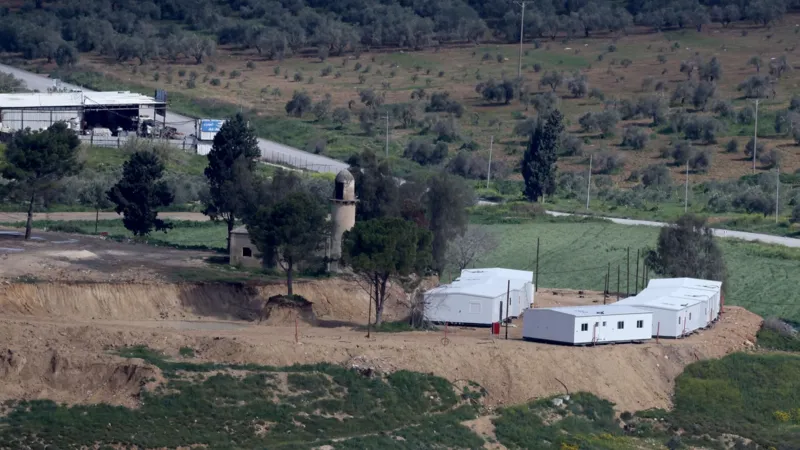 |
| Israel's far-right finance minister claims to have approved or retroactively authorised 69 new settlements (Image: EPA) |
All settlements are seen as illegal under international law. Outposts are set up without Israeli government approval.
"They [the settlers] have seen all the last three years as an opportunity, some say this is the time of 'a miracle'," says Yair Dvir, spokesman for the Israeli human rights group B'Tselem. "Israel's campaign of ethnic cleansing is continuing as we see it now on the ground." Israel strongly rejects that its actions amount to ethnic cleansing of Palestinians. "Forcible transfers, which appear to aim at a permanent displacement raise concerns over ethnic cleansing," the UN's human rights office added recently.
The first focus for settlers has been what is known as Area C of the West Bank - where Israel retained full security and administrative control after the 1993 Oslo peace accords. The accords divided the territory - temporarily, it was intended - into areas A, B, and C, with A and B under Palestinian civil and partial Israeli security control, and C under full Israeli control.
The UN humanitarian office reports that settler violence caused at least 4,765 Palestinians to be forced from 97 locations between January 2023 and mid-February 2026. The majority belonged to herding and Bedouin communities in Area C. 600 people were evicted from Ras Ein al-Auja, a Bedouin village in the Jordan Valley, at the start of this year. Now, settler violence is increasingly focused on built-up Palestinian villages - such as Deir al-Hatab - in Area B, where Israel has kept security control, but the Palestinian Authority has civil powers.
Allegra Pacheco, chief of party for the West Bank Protection Consortium, a partnership of international NGOs supported by foreign donors, states, "In areas where the Palestinian communities have been emptied out in C, the next step is happening. The settlers are going westward towards the B areas to continue the agenda of emptying out this land." "This is an intentional policy. This is not haphazard, some bad youth misbehaving. This is all the way to the top. The goal is to empty out these areas, to enable Israel to annex them, to expand the settlements, and deplete these areas of Palestinians."
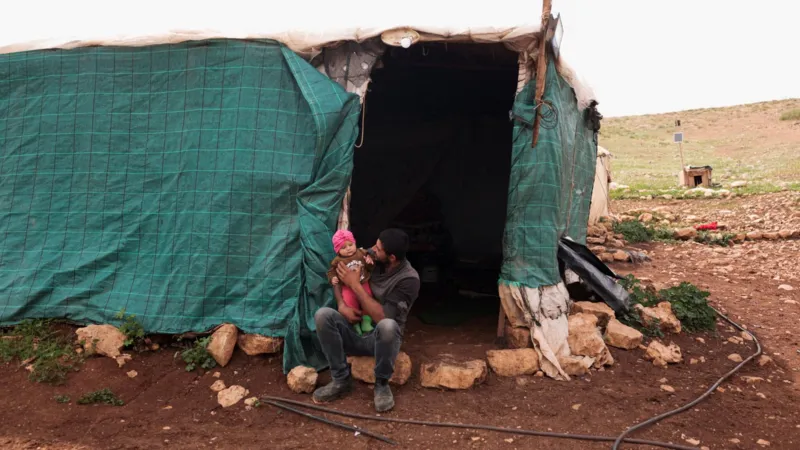 |
| Many Bedouin and herding communities have been displaced by settler violence in recent years (Image: Reuters) |
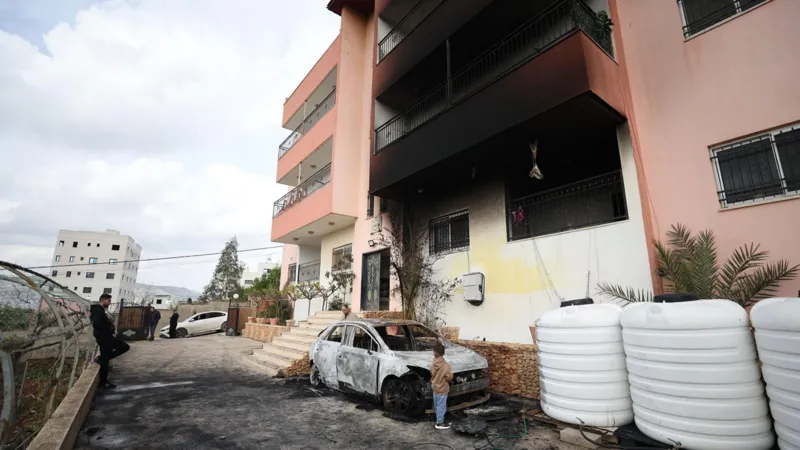 |
| Residents of Deir al-Hatab fear there will be further attacks on the village(Image: EPA) |
In the village, locals now fear a repeat of the violence.
From the rooftop of his burnt home, Samer Omar, a father-of-four, points out a new track on a nearby hill where settlers are planning another outpost.
"Soon, we'll be encircled," he says gloomily. "There's no safety anymore. I want to raise the wall four or five metres higher, but will that help? May God protect us all."
Barhan Omar, the bank manager who lives next door, responds in a more resolute manner, expressing concern about the possibility of a new Palestinian uprising as pressure mounts. "[Israeli Prime Minister Benjamin] Netanyahu should know that we won't stand watching," he says. "The Palestinian people will keep fighting for their lives and their land."
Source: BBC


 Posts
Posts


0 Comments