
 |
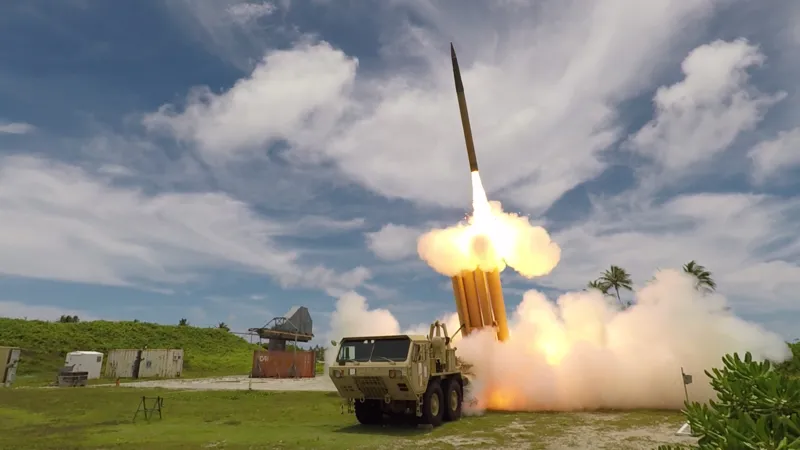
| The US currently operates eight Thaad systems across the world (Image: Lockhead Martin) |
According to officials cited by the Washington Post and South Korean news outlets, the United States is moving parts of a missile defense system that was installed in South Korea to the Middle East. Following reports that Iran had destroyed a key radar used by the Terminal High-Altitude Area Defense, or Thaad, system in Jordan, the alleged move comes 12 days into the US-Israeli war against Iran. In order to safeguard South Korea from threats posed by a nuclear-armed North Korea, Thaad was initially stationed there in 2017. South Koreans protested the move because they feared it would make them a bigger target, and China warned that it could destabilize the region.
What is Thaad - and why might it be moved?
According to two officials, the Washington Post reported earlier this week that a portion of the Thaad system was being relocated to the Middle East. The reports come as Iran responds with a barrage of drones and ballistic missiles directed at Israeli and US military bases in the region as the United States and Israel continue to strike the country. Iran has launched more than 500 ballistic missiles thus far, according to a New York Times count. However, the precise number of these missiles is unknown. Although the majority of them have been stopped, observers believe that Washington's military might be underutilized due to the volume of fire that is coming in. They also believe that Iran is preparing for a war of attrition that will ensnare more of the Middle East, including US allies, and that this will likely continue. That would explain why the US defense system relies so heavily on the Thaad, which is made to stop high-altitude missiles. In the beginning of this month, it was said that an Iranian strike had destroyed the Jordanian Thaad system's $300 million radar. The anti-missile system is made in the United States by Lockheed Martin and consists of six mounted launchers with eight interceptors on each launcher and a radar system for detection. It can shoot down short- and medium-range ballistic missiles, using hit-to-kill technology. That is, the incoming warhead is destroyed by kinetic energy.
It was thought to be especially useful in South Korea because it could be used to intercept and destroy a nuclear warhead because it can do this at a high altitude, beyond even the atmosphere of the Earth. A single system, or battery as it's known, costs roughly $1bn (£766m) and requires a crew of about 100 personnel to operate. Only eight of them are run by the United States globally, with Israel and Jordan serving as the two Middle Eastern locations. Saudi Arabia and the United Arab Emirates own three more. The potential redeployment from South Korea was a "precautionary measure", a US official told the Washington Post, but other analysts see a system stretched thin.
Prof. John Nilsson-Wright of Cambridge University told the BBC that the move would strongly suggest "the need for the US to compensate for its heavy use of existing missile defence capabilities in the Middle East."
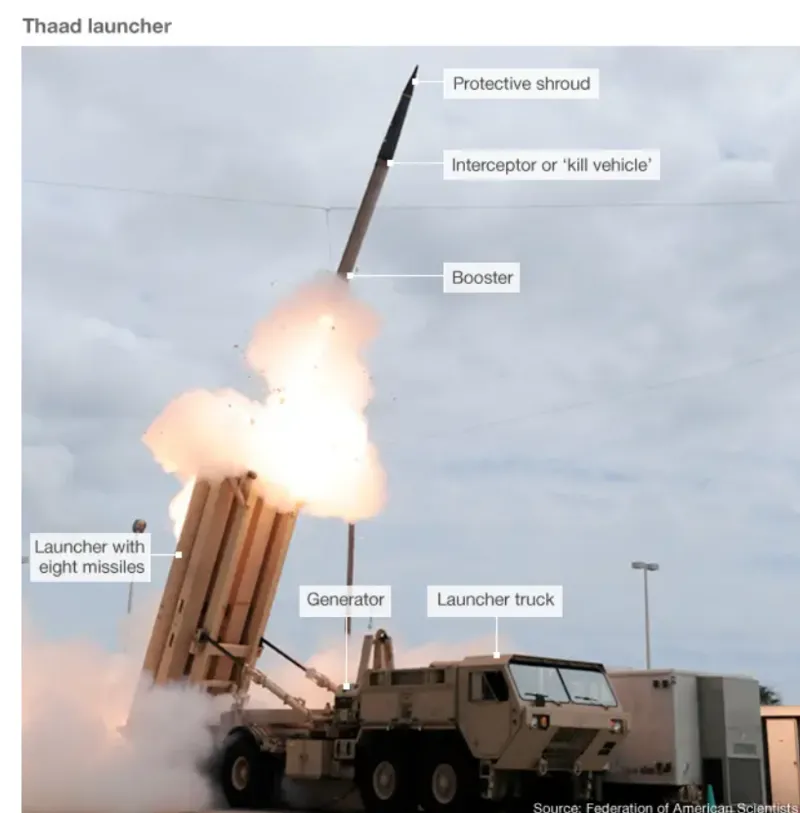 |
| South Korea is feeling the effects of the US moving some of its anti-missile system.(Image: BBC) |
According to reports from South Korean media outlets like SBS and Yonhap, Thaad launchers are already being moved out of the Seongju airbase, which is south of Seoul. Seoul had "expressed opposition" to the US withdrawal, President Lee Jae-myung acknowledged. During a cabinet meeting, he stated, "It appears that there has been controversy recently over US forces in Korea shipping some weapons, such as artillery batteries and air defense weapons, out of the country." "While we have expressed opposition, the reality is that we cannot fully push through our position."
When asked if this would hinder Seoul's deterrence strategy, he responded: "I can say with certainty that it would not."
According to Nilsson-Wright, Lee's words were an "unusual public expression of opposition to the move, highlighting Seoul's legitimate concerns that this [could] compromise South Korea's defense capabilities."
How have other countries reacted?
On Wednesday, when asked whether Beijing had any comment on the possible relocation, China's Foreign Ministry spokesman Guo Jiakun reiterated that "China's opposition to the US deployment of Thaad missiles in the Republic of Korea (ROK) remains unchanged".
China had been the most vocal critic when Thaad was installed in 2017.
First, it stopped Beijing's growing power and increased the US military presence in the region. China argued that the missiles' extremely powerful radar enabled them to see far into Chinese territory, despite Washington and Seoul's assertions that the missiles were intended to prevent North Korean attacks. So they could be used to spot Chinese missile launches, which affected Beijing's deterrent capability.
China responded by formally boycotting Korean goods, prohibiting group tours to South Korea for six years, and even canceling concerts featuring K-pop. While Beijing could celebrate the Thaad system being moved, it is unlikely to see that as a victory unless it becomes a "permanent removal", said Prof Ian Chong of the National University of Singapore.
However, Beijing could view the war in the Middle East as one that "distracts the US from its readiness in the Indo-Pacific", Nilsson-Wright said.
North Korea has not yet made any public remarks. According to Nilsson-Wright, Kim Jong Un, the country's leader, is unlikely to "exploit these changes." However, other observers believe that there is still a possibility that he could test the South with minor provocations. "Whether a prolonged conflict with Iran will deplete US missiles to the extent that responding to contingencies elsewhere becomes difficult," Chong stated, posing the most pressing concern.
Source: BBC


 Posts
Posts


0 Comments