Currently, the ants are flying in Kenya. Swarms of ants are seen leaving the thousands of anthills in and around Gilgil, a peaceful agricultural town in Kenya's Rift Valley that has become the hub of a booming illegal trade. During the mating ritual, winged males leave the nest to conceive queens, who then take flight. Because of this, now is the ideal time to capture queen ants and sell them to smugglers, who are at the center of a growing global black market that capitalizes on the pet craze for keeping ants in transparent enclosures so that people can watch them build a colony. International ant collectors place the highest value on the enormous, red African harvester ant queens, which can be purchased for up to £220 on the underground market, which typically operates online. Since scanners don't usually pick up organic material, a single fertilized queen can easily be posted because she can raise a whole colony and live for decades. "At first, I did not even know it was illegal," a man, who asked not to be named, told the BBC about how he had once acted as a broker, linking foreign buyers with local collection networks.
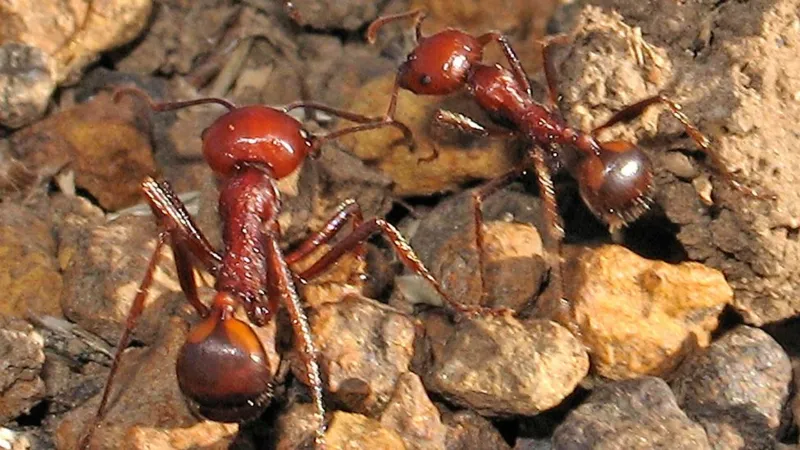
Also known as Messor cephalotes, these ants are native to East Africa and known for their distinctive seed-gathering behaviour making them popular with ant collectors.
"A friend told me a foreigner was paying good money for queen ants - the big red ones which are easily seen around here," the former broker said.
"Usually in the early morning, before the heat sets in, you look for the mounds near open fields. The foreigners never came to the fields themselves - they would wait in town, in a guest house or a car, and we would bring the ants to them packed in small tubes or syringes they supplied us with."
When 5,000 giant harvester ant queens, mostly collected around Gilgil, were discovered alive at a guest house in Naivasha, a nearby lakeside town popular with tourists, the scale of the illegal trade in Kenya became clear last year. According to the Kenya Wildlife Service (KWS), the suspects, who are from Belgium, Vietnam, and Kenya, had filled the test tubes and syringes with moist cotton wool, which would have allowed each ant to survive for two months. The plan was to take them to Europe and Asia and put them up for sale.
Scientists and authorities have been taken aback by this
ant trade. The East African nation is more accustomed to high-profile crimes against wildlife involving rhino horns and elephant tusks.
Dino Martins, a biologist based in Kenya, where there are approximately 600 types of ants, told the BBC, "Even I, as an entomologist, have been surprised at the extent of the apparent trade." However, he can understand the fascination with East Africa's harvester, with colonies created by a "foundress queen", who can grow up to 25mm (0.98 inches) and who produces eggs throughout her life.
"They are one of the most mysterious species of ants because they live in large colonies, exhibit fascinating behaviors, and are simple to keep. They don't act aggressively. He claims that the queens mate with a number of males during the swarming. The entomologist continues by explaining, "Then that is it for the males - their job is done... most are eaten by predators or die," and how the queen then scurries away to dig a small burrow and begin laying eggs to start her empire. The female soldier ants and her workers, which guard the nest, will eventually number in the hundreds of thousands.
"Nests have a lifespan that can exceed 50 years, possibly even 70 years. Martins stated, "I personally know of nests near Nairobi that are at least 40 years old because I have visited them for that long." This means the queens live that long too - because as soon as she dies, the colony collapses and any surviving workers will look for another nest.
Kenyans who have dealt with ants raiding their crops or invading their homes are well aware of this; in order to eradicate a colony, a person is sent in to locate the queen, who is frequently concealed deep within an ant mound's tunnels or chambers. According to the former broker, ants could also be collected by gently moving the mound and collecting them as they attempted to flee. He stated, "It wasn't until I saw the arrests on the news that I realized what I had been a part of - and I quit immediately." Those arrested were convicted on charges of
biopiracy and ordered to pay fines or serve 12 months in jail - they opted to pay the $7,700 fee and the foreign nationals left the country.
Two weeks ago, another 2,000 queen ants packed in test tubes and tissue rolls were taken into custody at Nairobi's Jomo Kenyatta International Airport (JKIA) by a Chinese national who is thought to have escaped using a different passport. This is cause for concern and has the potential to "wreak havoc" on the ecosystems in the area, according to
Zhengyang Wang, who was one of the researchers who contributed to a report on the ant trade in 2023 that focused on
China. "Initially, we were very excited when we learnt that many people have taken up keeping ants," Wang, assistant professor at Sichuan University, told the BBC.
"For the purpose of allowing keepers to observe colonies at work, digging tunnels, collecting food, and guarding their queen, pet ants are frequently kept in a
formicarium, which is essentially a transparent plastic box. I think it's pretty cute and could be a good way to teach people about insects and how they act. "But then we realized, wait, isn't it extremely dangerous to keep
invasive species?" The researchers observed online sales of more than 58,000 colonies in China over a six-month period and discovered that, despite being illegal to import, more than a quarter of the traded species were not native to China. According to Wang, "it's only a matter of time before a few escape from their formicaria and become established in the wild" if the volume of invasive ant trade continues. "For example, Messor cephalotes, an East African native, is among the largest seed harvesters in the world and could potentially disrupt predominantly grain-based agriculture in south-eastern China," stated the study he worked on, which was published in the journal
Biological Conservation. This species is one of the most traded in China. In Kenya, the effects on the environment are also a concern. "Harvester ants are both
ecosystem engineers and keystone species. They harvest seeds of grasses, and other plants and in so doing also help to disperse the seeds," said Martins, adding that the insects "create a more healthy and dynamic grassland".
Wang, an assistant professor at Sichuan University, told the BBC, "Initially, we were very excited when we learned that many people have taken up keeping ants." Wang was speaking to the BBC. "For the purpose of allowing keepers to observe colonies at work, digging tunnels, collecting food, and guarding their queen, pet ants are frequently kept in a formicarium, which is essentially a transparent plastic box. I think it's pretty cute and could be a good way to teach people about insects and how they act. "But then we realised, wait, isn't keeping invasive species incredibly dangerous?"
Monitoring online sales - of more than 58,000 colonies - in China over six months, the researchers found that more than a quarter of the traded species were not native to China - despite it being illegal to import them.
According to Wang, "it's only a matter of time before a few escape from their formicaria and become established in the wild" if the volume of invasive ant trade continues. "For example, Messor cephalotes, an East African native, is among the largest seed harvesters in the world and could potentially disrupt predominantly grain-based agriculture in south-eastern China," stated the study he worked on, which was published in the journal Biological Conservation. This species is one of the most traded in China. In Kenya, the effects on the environment are also a concern. "Harvester ants are both ecosystem engineers and keystone species. Martins said that the insects "create a more healthy and dynamic grassland" by harvesting grass and other plant seeds and aiding in their dispersal. These worries are shared by senior scientist Mukonyi Watai at Kenya's Wildlife Research and Training Institute. He stated to the BBC, "Unsustainable harvesting, especially the removal of queen ants, can lead to colony collapse, disrupt ecosystems, and threaten biodiversity." In accordance with various international treaties, it is legal to collect ants in Kenya with a special permit. However, the buyer must sign a benefit-sharing agreement with the involved local community to split any profits. But, according to the KWS, so far none have been applied for - with the paperwork also requiring details of how many ants are being collected and their destination.
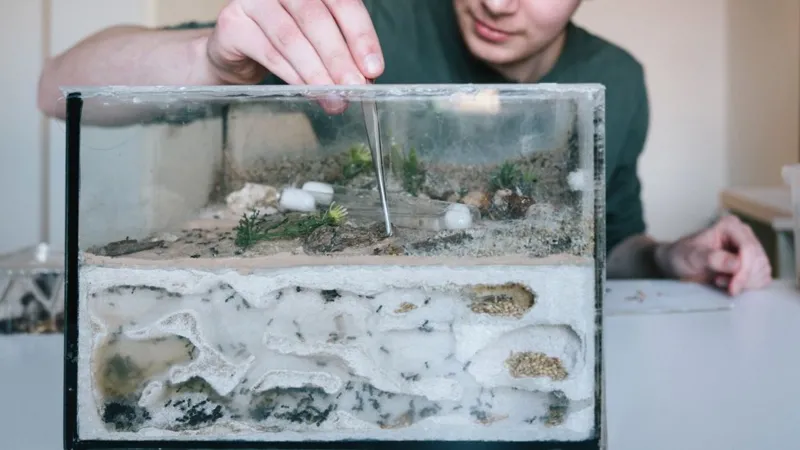 |
| A formicarium allows collectors to see the workings of an ant colony(Image: Getty Images) |
Under the Convention on International Trade in Endangered Species (Cites), a global wildlife trade treaty, some conservationists are calling for greater trade protections for all ant species. "The reality is that no ant species is currently listed under Cites," Sérgio Henriques, a researcher into the global ant trade, told the BBC.
"Without international treaties monitoring these movements, the scale of the trade remains largely invisible to policy makers and the global community," he said.But for the KWS the real problem is more immediate - how to monitor and clamp down on "under-reported" insect trafficking, with the agency suggesting better surveillance equipment at airports and others border points would be a good start.
Martins concurs: "One can only guess at the scale for the time being because it is likely only a fraction of the actual ants being traded that are being detected."
Charles Onyango-Obbo, a journalist, contends that Kenya is ignoring a substantial global revenue opportunity. "Unlike diamonds or gold, ants are not inexhaustible resources. They are biological resources that can be bred and raised in farms, and their daily production can reach a thousand. But we treat them like stolen artifacts," he wrote in a recent article published in the
Kenyan Daily Nation newspaper. In fact, policy guidelines aimed at commercializing the wildlife economy, including the ant trade, were approved by
Kenya's cabinet last year. "The guidelines seek to promote sustainable use trade of wild species such as ants to generate jobs, wealth and community livelihoods across all the counties," said Watai.
It is possible that future farmers in the Gilgil area will have special formicaria on their land, expanding the yields from their fields and orchards, which are full of fruits and vegetables, to include lucrative queen ants with careful monitoring. However, the issue of whether or not it is safe to ship ants to hobbyists in different parts of the world remains open.
Source: BBC



 Posts
Posts


0 Comments