
 |
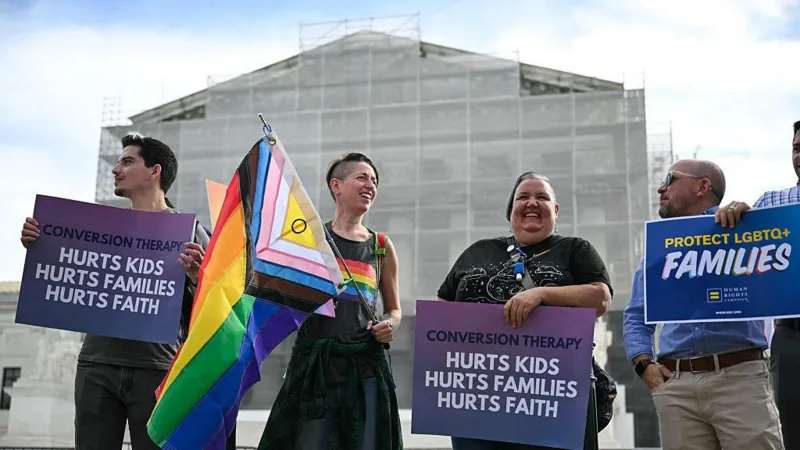
| Critics of conversion therapy say it can be emotionally harmful, cause mental health issues and increase risk of suicide (Image: Getty Images) |
The US Supreme Court has ruled against a law in Colorado that bans so-called conversion therapy for lesbian, gay and transgender people.
It sided 8-1 with a therapist from Colorado Springs who argued that the state's restrictions violated her free speech rights guaranteed under the US Constitution's First Amendment.
Conversion therapy - which professional and health associations denounce but some religious conservatives promote - aims to encourage lesbian, gay and transgender people to change their sexual orientation or gender identity.
Lower courts had "erred by failing to apply sufficiently rigorous scrutiny" to restrictions on free speech, according to the justices' decision. Kaley Chiles, a licensed counselor and practicing Christian in Colorado Springs, argued that the ban in her state prevented her from treating people who "prioritise their faith above their feelings" and have "same-sex attractions or gender identity confusion." Chiles argued that the law violated her First Amendment rights by preventing her from providing talk therapy to clients who want her assistance in "reducing or eliminating unwanted sexual attractions (or) changing sexual behaviors." Justice Neil Gorsuch concurred in the majority opinion, stating that Colorado's law "censors speech based on viewpoint." According to the opinion, "The First Amendment stands as a bulwark against any attempt to prescribe an orthodoxy of views, reflecting a belief that each American enjoys an inalienable right to speak his mind and a faith in the free marketplace of ideas as the best means for finding truth."
READ MORE: Supreme Court will hear challenge to Colorado conversion therapy ban
The justices emphasized that "no physical interventions or medications" are used in Chiles' talk therapy. The case is remanded to lower courts as a result of the decision. According to officials in Colorado, the law does not regulate speech but rather the conduct of mental health professionals. Additionally, they argued that the law does not prohibit discussions of sexual orientation and gender identity. But the majority of justices said "the First Amendment's protections extend to licensed professionals much as they do everyone else".
Ketanji Brown Jackson, a justice on the Supreme Court, was the only one to vote against it. She said that her fellow justices had failed to take into account the fact that Chiles was speaking as a medical professional and that "First Amendment principles have far less salience when the speakers are medical professionals." She was the only justice to vote against it. Jackson wrote, "Chiles is providing therapy to minors as a licensed healthcare professional; she is not speaking in the ether." Jackson also wrote that "such professionals are already subject to a number of other restrictions on their professional practice," such as the requirement that "licensed therapists must provide therapy that is consistent with the standard of care" under Colorado law. More than 20 US states have banned conversion therapy for minors.
When the justices heard oral arguments in the case in October, they appeared to be skeptical of the law. In 2022, Chiles filed a lawsuit regarding the Colorado law, but a number of lower-level courts denied her request to halt the law's implementation. She filed an appeal with the Supreme Court last year. A report from the Trevor Project for the year 2023 says that conversion therapy is offered by more than 1,300 practitioners all over the US. Jaymes Black, the leader of the LGBT advocacy group, said in a statement that the court's decision was "painful." "A tragic step backward for our country that will put young lives at risk is the Supreme Court's decision to treat the dangerous practice of conversion therapy as constitutionally protected speech," Black stated. "These efforts, no matter what proponents call them, no matter what any court says, are still proven to cause lasting psychological harm."
Conversion therapy is criticized for its potential for emotional harm, mental health issues, and an increased risk of suicide. Talk therapy or prayer are used by some practitioners, but in extreme cases, patients have been subjected to physical violence and starvation. According to the American Medical Association, there is no medical evidence to support the claim that nonconforming gender identity or same-sex attraction are mental disorders.
Source: BBC


 Posts
Posts


0 Comments