The shock of war in the Middle East has not yet hit China. However, it is noticing the changes. It has sufficient oil supplies for several months in the short term, after which it may turn to its neighbor Russia for assistance. But China will be calculating what this could mean long-term - not just for its investments in the Middle East, but also for its ambitions.
As the world's second-largest economy continues to struggle with low consumption, a prolonged property crisis, and enormous local debt, thousands of Communist Party delegates will gather in Beijing this week to discuss a strategy. Even as Beijing continues to rapidly develop high-tech and renewable energy industries, China lowered its annual economic growth target on Thursday to the lowest level since 1991. It's possible that China wanted to export to get out of its economic problems. However, it has been engaged in a trade dispute with the United States for a year and now faces the possibility of turmoil in the Middle East, which supplies many of its energy requirements and its major shipping routes. The longer the war drags on, the more it could hurt, especially if traffic through the Strait of Hormuz remains blocked.
Read More: 'Every day feels like a month': Iranians describe life under US-Israeli strikes
According to Philip Shetler-Jones of the Royal United Services Institute, "other regions of importance for China will be disrupted by a prolonged period of turmoil and insecurity in the Middle East." "For instance, the economies of Africa have benefited from substantial and consistent capital flows from the Gulf. The sustainability of China's broader and longer-term interests is jeopardized if the investment tide turns against it. This means that a prolonged war could also affect China's investments and markets outside of the Middle East because of its global reach. China, like many other nations, is wary of this new round of unpredictability. "I think China is thinking the same as everyone else," says Professor Kerry Brown, director of the China Lau Institute at King's College London.
"What is the strategy? The Americans certainly did not enter this without a strategy. "Probably, along with everyone else, they would also be thinking, oh God, they really have gone into this without any plan at all," he continues. Right, we don't want to get dragged into this like we don't want to get dragged into anything else, but we also need to do something."
Not-so-firm friends
Many Westerners have always referred to Iran as a China "ally." They have undoubtedly been extremely friendly.
Ali Khamenei, the Supreme Leader of Tehran, made his last trip to another country in 1989, to Beijing. By the Great Wall, a photographer took his picture.
 |
| Ali Khamenei with China's then-president Yang Shangkun in May 1989 (Image: Getty Images) |
During
Xi Jinping's visit to Tehran in 2016, their relationship grew stronger, and in 2021, they agreed to a
25-year strategic partnership. China promised to invest $400 billion (£300 billion) in Iran over 25 years in exchange for Iran continuing to supply oil. Analysts, on the other hand, believe that only a small portion of that money has reached the Iranians. But the oil continued to flow. The Center on Global Energy Policy estimates that China will import 1.38 million barrels of crude oil per day from Iran in 2025, or about 12% of China's total crude oil imports. It is alleged that many of these barrels were disguised as Malaysian by changing their labels. A report from the Columbia University research center claims that the
National Iranian Oil Company leases tanks in the Chinese ports of Dalian and Zhoushan, where there are more than 46 million barrels of Iranian oil in floating storage and even more in bonded storage that has not yet been cleared by customs. Additionally, there are allegations of arms sales between the two nations. China has denied selling Tehran anti-ship cruise missiles, but
US intelligence has accused Beijing of supporting Iran's ballistic missile programme by training engineers and supplying components.
Rights groups have alleged that Beijing-shared Chinese facial recognition and surveillance technology contributed to Iran's brutal crackdowns on protesters and regime critics. It might appear as though the two were close friends. Even newspaper headlines grouped China and Iran together with North Korea and Russia as an "axis of upheaval." All four do want to challenge the
US-led world order, but in truth their relationship was transactional.
Prof. Brown asserts, "There is no real ideological or cultural reason why China would get along with Iran." "Iran's constant annoyance to the US served China's almost "divide and rule" strategy at times. Therefore, I believe China's desire for a relationship with Iran is primarily motivated by negative rather than positive factors. "That's a very weak foundation for a relationship, but it worked for a while. However, the relationship was not particularly deep. China views its "alliances" differently from the West. It does not sign agreements for mutual defense and will not immediately assist its ally. Beijing, on the other hand, wants to stay out of any conflict.
Leading the charge:
However, this does not imply that China is not deeply concerned by the events in the Middle East. Beijing called for a ceasefire and issued a predictable, muted condemnation. "Unacceptable for the US and Israel to launch attacks against Iran... even less to blatantly assassinate a leader of a sovereign country and instigate regime change," said Chinese Foreign Minister
Wang Yi. The fact of the matter is that Washington's actions in Iran and Venezuela in January have demonstrated the limitations of those nations' partnerships with China. Beijing has been left on the sidelines as an observer in both instances, unable to assist those in its orbit. According to Philip Shetler-Jones of the Royal United Services Institute, China is attempting to position itself as a "responsible counter-balance" to the United States; however, "in terms of military balance, the US is demonstrating what being a superpower really means, which is the ability to force outcomes in theatres across the globe." Despite its economic might, he argues, Beijing is not "a superpower on the same level." Even if it wanted to, "It is not equipped to protect its friends against this kind of action." In contrast to
Donald Trump, Xi will continue to position himself as a global leader who is stable and predictable to counter these concerns. According to Professor Steve Tsang, director of the SOAS China institute, "China's argument will be that Donald Trump has once again demonstrated beyond any doubt the extent of western hypocrisy and western talk of the liberal international order."
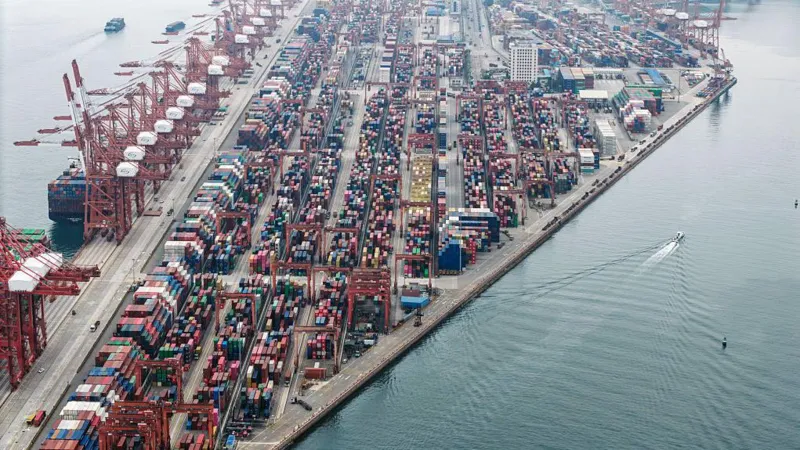 |
| China's Shenzhen port is just one of many that relies on shipping routes which run through the Middle East(Image: Getty Images) |
He adds that this conflict will "have far greater ramifications economically in the Global South than in the West" as a result of disruptions to air travel and energy supply. "In a few months, some countries in the Global South will experience a food shortage. The Western alliance is already breaking apart, with Spain and the United Kingdom being targeted for attack." Beijing may also see an opportunity to assist in the mediation of negotiations with other nations. China has confirmed that it will send a special envoy to the Middle East, and Foreign Minister Wang Yi has already spoken with his counterparts in Oman and France.
Trump's looming visit:
Despite this, China is being cautious because the unpredictable US president's arrival for a much-anticipated meeting later this month is one of their biggest calculations. Trump has not been directly targeted in any of China's criticisms of US and Israeli strikes on Iran, which may make it easier to shake hands. Some people have wondered if the visit could still happen. But there are indications that it is still on. According to Reuters, a meeting of officials from both sides is scheduled to discuss the trip. Shetler-Jones says that China may see this as an opportunity to "look for cues" on how Trump might react to other flashpoints like
Taiwan, the self-governing island that China claims. "To the extent that this war proves to be unpopular, it may contribute to a growing trend of "restraint" in US foreign and security policy that, if implemented by a subsequent administration, would allow China to pursue its interests in its own region and the world at large." The People's Liberation Army has used social media to portray Washington as a warmongering nation as a result of this crisis. Prof. Brown, on the other hand, suggests that Beijing's presence of such "an unpredictable and a dysfunctional actor" may be cause for concern. "I don't think China wants a world where the US is so unstable," China said. "They don't really want a world where the US is so dominated by the US."
Source: BBC


 Posts
Posts


0 Comments