
 |
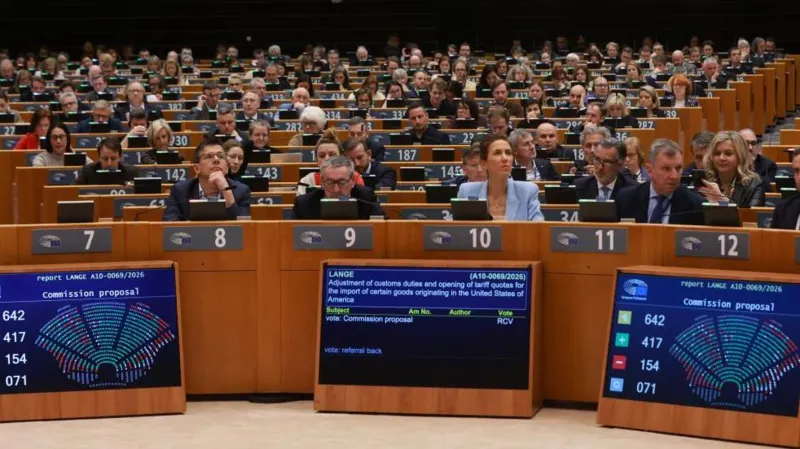
| The European Parliament has backed legislation to implement an EU-US trade deal (Image: EPA) |
After months of uncertainty regarding President Donald Trump's threats of tariffs, the European Parliament has supported legislation to implement a trade agreement between the EU and the US. On Thursday, the measures were approved by the majority of lawmakers, but a number of safeguards were added to ensure that the United States honors its side of the agreement that was reached in July. The legislation would set tariffs at 15% for most EU goods - down from the 30% initially threatened - in exchange for European investment in the US and the removal of EU import duties on US industrial goods.
The vote comes after months of delay following Trump's threats to annex Greenland and a US Supreme Court ruling that found some of his tariffs unlawful.
The legislation was approved by a vote of 417 to 154, with 71 abstentions, in the EU assembly. The text will need to be signed off by all of the bloc's 27 member states before it is implemented, with a concluding vote expected in April or May.
The agreement's safeguards were strengthened on Thursday by lawmakers, who included a provision to suspend it in the event that the United States imposes new duties or tariffs on EU goods or imposes additional tariffs above 15%. If the US threatened the EU's territorial sovereignty, another would stop the deal. MEPs also included a "sunrise clause" that means EU tariff reductions will only take effect if the US upholds its side of the bargain - including lowering tariffs to 15% on EU products that contain less than 50% steel and aluminium.
When the framework agreement was announced last summer, Trump said the 50% US tariff on global steel and aluminium would still apply to the EU. But on Thursday the parliament voted that it will only accept zero tariffs on US goods if hundreds of European goods made with steel and aluminium are excluded from that 50% tariff. A "sunset clause" will see the agreement end by 31 March 2028. "At this stage, we have received reassurances from the US that they intend to honour the deal," European economy commissioner Valdis Dombrovskis said after the vote.
"While we will continue our efforts to maintain constructive relationships and avoid volatility, we will not turn a blind eye to any risks to our interests."
EU trade commissioner Maros Sefcovic described the vote as a "crucial step".
The framework agreement was made during a meeting between European Commission President Ursula von der Leyen and Trump at the president's Turnberry golf course in Scotland last July.
Von der Leyen hailed it as a "huge deal," while Trump said it was a "good deal for everybody".
At the time, Trump stated that the EU would spend $750 billion on energy and increase its investment in the US by $600 billion (£446 billion), which would include the purchase of American military equipment. Von der Leyen said increased purchases of American liquified natural gas, oil and nuclear fuels would help reduce Europe's reliance on Russian energy.
The US and the European Union are each others' largest trading partners.
According to European statistics, goods and services worth more than €1.6 trillion (roughly £1.4 trillion) were exchanged in 2024, accounting for nearly a third of all global trade. Trade in goods alone totalled about $976bn in 2024. The US imported roughly $606bn in goods from the EU and exported around $370bn.
Trump has wielded tariffs against many US trading partners in what he describes as an effort to reduce the US trade deficit and reshape the global trading system.
Since Trump's announcement of global tariffs on "Liberation Day" last year, the EU has sought to diversify its trade relationships.


 Posts
Posts


0 Comments