According to Israeli emergency officials, Iranian missile strikes on two southern Israeli towns close to a nuclear facility have injured more than 160 people, some seriously. Ballistic missiles struck the towns on Saturday evening, according to reports, injuring 84 in Arad and 78 in Dimona. The International Atomic Energy Agency (IAEA) says it is not aware of any damage to the nuclear research facility located about 13km (eight miles) outside Dimona.
Read More: Trump at a crossroads as US weighs tough options in Iran
The strikes were earlier reported by Iranian state television to be in response to a Saturday attack on Iran's nuclear facility in Natanz. According to the emergency services, an Iranian missile attack on Tel Aviv on Sunday left at least seven people injured.
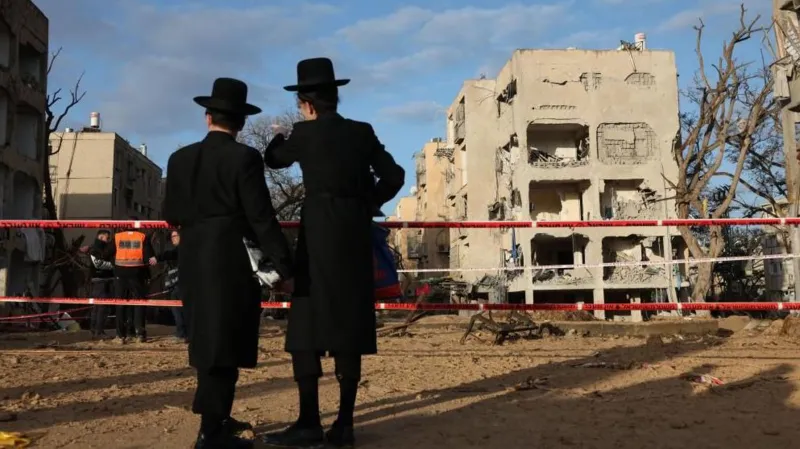 |
| Ultra-Orthodox Jewish residents look at the scene of a direct hit in Arad (Image: EPA) |
Since the US-Israeli attack on Iran on February 28, according to the Israeli Air Force, Tehran has fired 400 missiles at Israel. It adds that 92% of these were intercepted. Residents of Arad described the Saturday explosions as terrifying. A large crater was left behind by the missile's severe damage to several buildings. A paramedic in the town named
Naram Zaid told BBC News that she had seen "a lot of children with head and chest injuries" after objects had crushed them inside a damaged building. She went on to say, "I was trying to reassure a 10-year-old girl with head injuries and blood on her face from broken glass." "We waited for her parents to be evacuated from the destroyed apartment block before we sent them all to the hospital because she was refusing to get into the ambulance because her parents were still inside the building." The outside walls of two residential apartment buildings were gouged out by the impact.
In this ultra-Orthodox town in the Negev desert, a lot of men in dark suits stood there and stared at the damage.
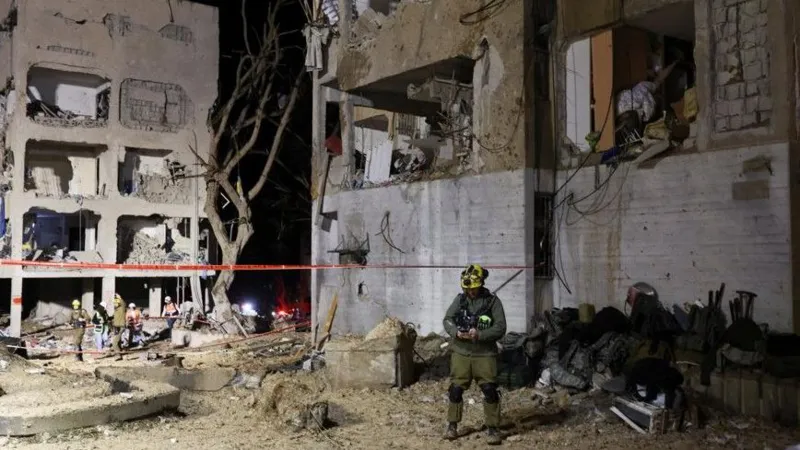 |
| A large Iranian missile shattered apartment blocks in Arad, southern Israel (Image: Reuters) |
A similar missile attack occurred in Dimona, a nearby town. A 10-year-old boy was among the numerous injured. His condition was considered serious by doctors. "In both Dimona and Arad, interceptors were launched that failed to hit the threats, resulting in two direct hits by ballistic missiles with warheads weighing hundreds of kilograms," Israeli firefighters said.
Both Israeli Prime Minister
Benjamin Netanyahu and President Isaac Herzog visited the impacted sites on Sunday.
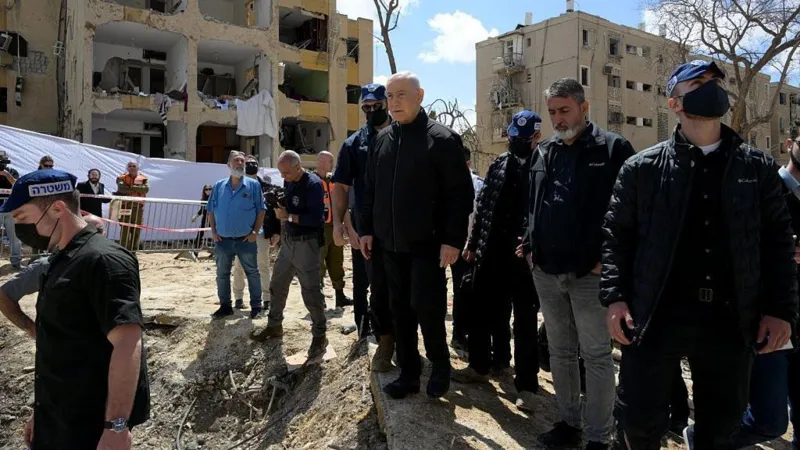 |
| Netanyahu (centre) inspects damage in Arad (Image: Getty Images) |
A reminder of the human cost of the war is Iran's continued ability to cause such damage inside Israel. To determine how the missiles broke through
Israel's air defense system, urgent investigations are being conducted. But as in the 12-day war last summer, Israelis know that the system is not infallible.
Similar to then, these attacks are more likely to strengthen than weaken the public's resolve.
Officially, the site is said to be only used for research. However, it has been known for about six decades that Israel made a nuclear bomb there, even though every government since has been vague about it. It has meant that Israel is the only nuclear power in the Middle East. Israel therefore treats any sign that it is being targeted with the utmost seriousness.
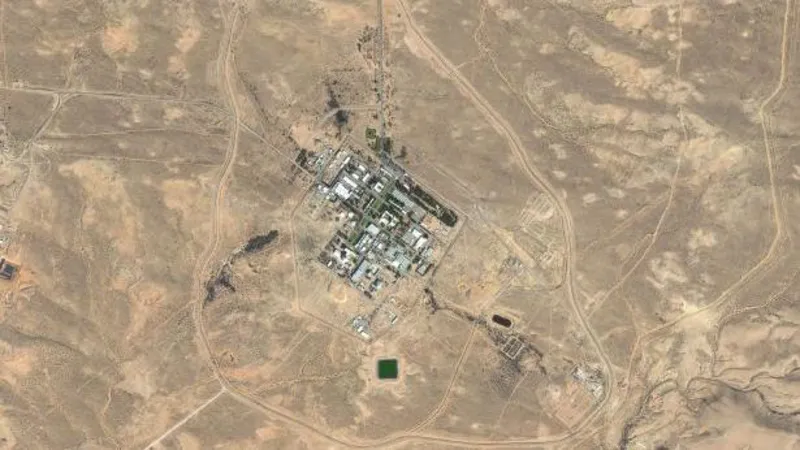 |
| A satellite image of the Shimon Peres Negev Nuclear Research Facility, taken in 2020 (Image: Maxar) |
The primary objective of the war, according to Israel and the United States, is to eliminate any Iranian capability to develop a nuclear bomb. Iran's own Atomic Energy Organisation described the attack on Natanz as a violation of the
Treaty on the Non-Proliferation of Nuclear Weapons, though it said "no leakage of radioactive materials" was reported and there was "no danger to residents of the surrounding areas".
US-Israeli strikes also targeted Natanz in the first days of the war, which began on February 28, as well as during the 12-day war in June. On Saturday, when questioned about Natanz, the Israel Defense Forces informed international and Israeli media that they were unaware of any strikes in the vicinity.
Source: BBC





 Posts
Posts


0 Comments