
 |
| Housing Secretary Steve Reed: "The UK is not going to be dragged into this war" (Image: BBC) |
There is "no assessment to substantiate" Israel's claim that Iran has long-range missiles capable of reaching London, a UK cabinet minister has said.
After the Israel Defense Forces (IDF) reported on Saturday that Tehran had weapons that could reach up to 4,000 kilometers (2,000 miles), Housing Secretary Steve Reed told the BBC that there was "no specific assessment that the Iranians are targeting the UK - or even could if they wanted to." It comes after it was revealed that Iran had targeted the Chagos Islands, a joint US-UK military base in the Indian Ocean that is approximately 3,800 kilometers from Iran. "Operational details" prevented Reed from disclosing how close the missiles came to the British overseas territory.
Read More:Iranian missiles injure 160 in towns near Israeli nuclear site
Reed stated that Iran launched two ballistic missiles at Diego Garcia, one of which was unsuccessful and missed, while the other was intercepted. The intercepted missile disappeared after a US destroyer fired missiles at it, according to the Wall Street Journal, which first reported the strikes, citing US officials.
The Israeli Defense Forces (IDF) stated on Saturday, shortly after the attempted attack was reported, that they had previously disclosed Tehran's intention to develop missiles that could reach Europe, Asia, and Africa. "We have been saying it: The Iranian terrorist regime poses a global threat," the statement continued. Now, with missiles capable of reaching Berlin, Paris, and London. Asked whether this was true, Reed insisted that there was "no specific assessment that the Iranians are targeting the UK or even could, if they wanted to".
He told Laura Kuenssberg on Sunday, "We are perfectly capable of protecting this country and keeping this country safe, whether it's here at home or our assets and nationals across the region." When pressed once more regarding the remarks made by the IDF, he responded, "There is no assessment to substantiate what's being said." He asserted that the British armed forces would be able to defend the UK even if Iran could launch strikes at such a distance.
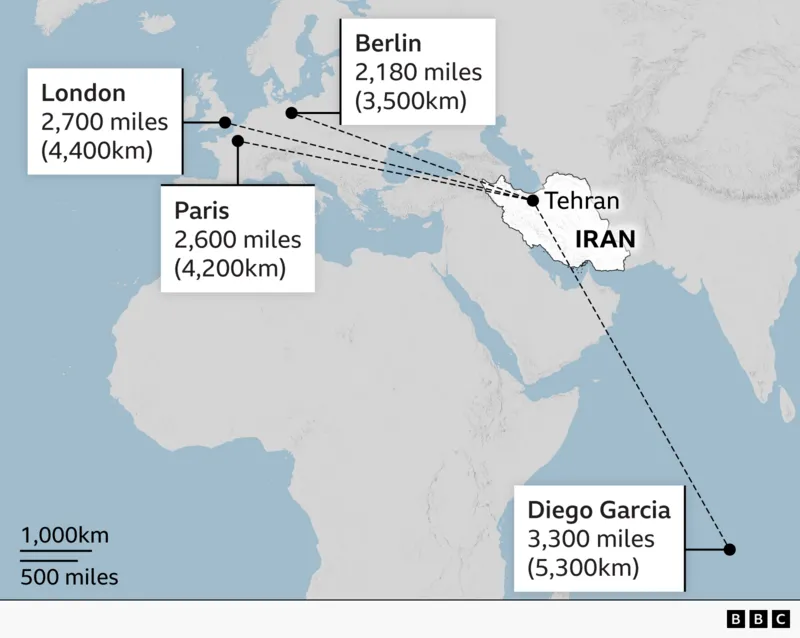
The longest-range weapon in Iran's arsenal is thought to have a maximum range of 2,000km, far short of both Diego Garcia and London - even if fired from just inside the nearest Iranian border.
Days before the United States and Israel began their attacks on Iran, US President Donald Trump claimed that Iran was working on developing missiles that could "threaten Europe" and strike the United States. "We don't want to be felt as a threat by anybody else in the world," Iran's foreign minister stated earlier this month, referring to the country's deliberate limitation of its missile range to 2,000 kilometers. Israeli Prime Minister Benjamin Netanyahu insisted on Sunday that Iran had the "capacity to reach deep into Europe".
Reed's Conservative counterpart Sir James Cleverly told the programme that Iran was deploying "very, very long-range missiles", but would not be drawn on whether these were capable of hitting the UK as he was no longer privy to the intelligence reports he had received as foreign secretary.
Dr Sidharth Kaushal, a senior research fellow at the Royal United Services Institute, said: "Missile range is an elastic thing - in that if you put a lighter warhead on a missile, you can extend its range".
He said that while it was "probably accurate" that Iran had missiles capable of reaching the UK, it was "not the most pressing threat" because these weapons are inaccurate at long distances and would have to travel through very well-defended airspace to enter UK airspace.
He said: "The big question is: So what? If you can launch a small number of conventionally-armed ballistic missiles over well-defended airspace... and they're quite inaccurate at very long ranges… what would the Iranians be trying to achieve?"
Israel's claims about Iranian capabilities should be taken "seriously, but as seriously as the potential for Russian missiles to come this way as well," according to retired British Army general and former Nato commander Sir Richard Shirreff. He stated to Broadcasting House on BBC Radio 4: "But I would also say that of course Israel is going to say this, because it is in Israel's interest to broaden the war, to bring in as many nations as possible."


 Posts
Posts


0 Comments