 |
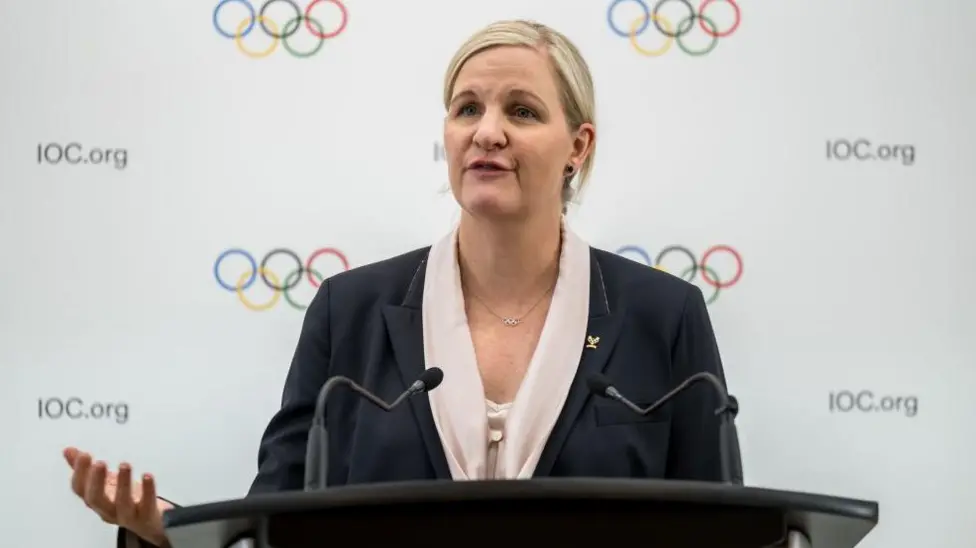
| Olympic president Kirsty Coventry was elected to the role one year ago (Image: Getty Images) |
The women's category of Olympic sports will be limited to biological females from 2028.
The International Olympic Committee (IOC) says eligibility will be determined by a "once-in-a-lifetime" sex test, which would prevent transgender women and those with differences in sexual development (DSD) who have gone through male puberty from competing.
It will take effect from the Los Angeles Olympics.
IOC president Kirsty Coventry said the policy was "led by medical experts".
"At the Olympic Games even the smallest margins can be the difference between victory and defeat," she said.
Therefore, it is abundantly clear that it would not be equitable for biological men to compete against females. In addition, in some sports it would simply not be safe."
The IOC said eligibility for the female category would be determined by a screening to detect the SRY gene - the sex-determining region Y gene - which is part of the Y chromosome and causes male characteristics to develop.
"The IOC considers that SRY gene screening via saliva, cheek swab or blood sample is unintrusive compared to other possible methods," it said.
"Athletes who screen negative for the SRY gene permanently satisfy this policy's eligibility criteria for competition in the female category.
"This will be a once-in-a-lifetime test, unless there is reason to believe that a negative reading is in error." The IOC said athletes who fail the test would "continue to be included in all other classifications for which they qualify. They are, for instance, eligible to participate in any male category, including a male-only slot in a mixed category or an open category, as well as in sports and events that do not classify athletes according to sex."
What does trans mean and why is there a debate about transgender people's rights?
Until this announcement, the IOC left sex eligibility regulations to the governing bodies of individual sports, rather than applying a universal approach.
While athletics, swimming, cycling and rowing have brought in bans, many others allowed transgender women to compete in female competition if they lowered their
testosterone levels.
The ban will also cover almost all athletes with a DSD.
This is a rare condition in which a person's hormones, genes and/or reproductive organs may be a mix of male and female characteristics.
Two-time Olympic women's 800m champion
Caster Semenya's DSD means she has male XY chromosomes.
Previously, DSD athletes who had not been through male puberty could compete in women's sport, provided they kept their testosterone within certain levels.
The policy makes one exception for DSD athletes who do not have male puberty because they have a rare condition called complete androgen insensitivity syndrome (CAIS).
'A hugely significant decision' - analysis
Following years of controversy regarding the participation of transgender and DSD athletes in female competition, as well as intense debate regarding how sports should strike a balance between fairness and safety, this is a hugely significant decision made by the IOC. In a reflection of just how sensitive an area of policy this has become, the IOC has traditionally left it to international sports to decide on eligibility criteria for female competition. All federations, on the other hand, will now be expected to comply with a significant policy shift. A blanket ban on transgender athletes and DSD athletes from women's sport will be welcomed by many who have long felt that such a move is essential if fairness and safety in the female category is to be preserved.
Supporters say this approach - based on a genetic test - has recently been successfully employed in athletics and boxing, and is a reliable, confidential and proportionate approach that has the backing of sports scientists, along with the vast majority of athletes.
They also say this method is more humane than requiring transgender or DSD athletes to suppress their natural testosterone levels, and will avoid the intense media scrutiny that some athletes have been subjected to.
Opponents remain concerned, however, that the approach is invasive, and that there is a risk of accidental contamination and a potential false positive.
In a report that was submitted this month to the British Journal of Sports Medicine, a group of academics called sex testing a "backwards step and a harmful anachronism." They also said that testing violates the human rights of athletes and could cause stigma and psychological distress. They said it was "a simplistic way of reducing a characteristic to a single gene, which does not reflect the complex nature of sex".
The IOC used the SRY gene test in the 1980s but, after a number of 'false positives', and fears that female athletes were being punished for natural variations, sex verification tests were abolished in the 1990s.
Now, under mounting pressure, sport's most powerful body has embarked on a new approach, and it will be fascinating to see if it now faces any legal challenges.
How the IOC reached its decision
"Male sex provides a performance advantage in all sports and events that rely on strength, power, and endurance," according to the IOC, whose working group said it reviewed the most recent scientific evidence over the past 18 months. It consulted a "wide range of experts in relevant fields" and an online athlete survey that had more than 1,100 responses.
Interviews were also conducted with "impacted athletes from around the world".
The IOC said: "Feedback from the athlete consultation revealed that, although nuances exist across sex and gender, region and athlete status (active/retired), there was a strong consensus that fairness and safety in the female category required clear, science-based eligibility rules, and that protecting the female category is a common priority."
The move does not apply to any grassroots or recreational sports programmes, and the IOC said the findings of any tests would not be applied retrospectively.
Coventry stated, "Athletes will only need to be screened once in their lifetime, and every athlete must be treated with dignity and respect." "In addition to expert medical advice, there must be clear education about the process and counseling available."
Transgender and DSD athlete controversies
In recent years a growing number of sports federations, including World Aquatics and
World Athletics, have barred athletes who have undergone male puberty from competing in elite female competition amid concerns over fairness and safety.
Following the UK Supreme Court's decision in May that the legal definition of a woman was based on biological sex, the Football Association and England and Wales Cricket Board were among a number of British sports bodies to follow suit. The moves have been opposed by trans rights campaigners who argue they could violate human rights, and insist inclusion should be prioritised.
However, transgender women are prohibited from competing in female categories by an executive order signed by US President Donald Trump this year. He said it would include the 2028 Olympics and that he would deny visas for transgender athletes trying to visit the US to compete at the Games.
After being selected for the women's weightlifting team at Tokyo 2020, New Zealand's
Laurel Hubbard became the first openly transgender woman to compete at an Olympics. The Paris 2024 Olympics were engulfed in controversy after Algeria's Imane Khelif won the women's welterweight boxing gold medal, a year after being disqualified from the World Championships for reportedly failing a gender eligibility test.
The IOC cleared the 25-year-old to compete, along with Taiwan's Lin Yu-ting, who was also banned by the suspended International Boxing Association (IBA).
The IOC said competitors were eligible for the women's division if their passports said they were female.
Some reports took the IBA saying Khelif has XY chromosomes to speculate that the fighter might have DSD. However, the BBC was not able to confirm whether this was or was not the case.
Last week it was announced that Lin could return to women's sport after passing a sex test.
At the 2016 Olympics in Rio, all three medallists in the women's 800m, including winner Semenya, were DSD athletes, intensifying calls for tighter rules.
World Athletics then insisted that for track events from 400m up to the mile, DSD athletes must reduce their testosterone levels in order to be eligible.
Semenya refused, arguing it was an infringement of her human rights and discriminatory.
Amid a long legal battle, World Athletics' made its rules stricter in 2023.
Source: BBC


 Posts
Posts


0 Comments